Determining how many high mast lights a project needs is not as simple as dividing the total area by the coverage of one pole. A reliable high mast lighting design calculation must consider the required illuminance, fixture lumen output, mounting height, optical distribution, maintenance losses, site geometry and number of LED fixtures installed on each mast.
A basic calculation can provide a useful quantity estimate during the budgeting and concept-design stage. However, the result should still be verified through a professional lighting simulation before pole foundations, electrical cables and high mast locations are finalized.
What Does a High Mast Lighting Design Calculation Determine?
A high mast lighting calculation normally provides two related but different results:
The approximate number of LED luminaires needed to produce the required light output.
The approximate number of high mast poles needed to carry those luminaires and distribute the light across the site.
These numbers should not be confused. A calculation may show that a project needs 24 LED floodlights, but those fixtures could be arranged as six masts with four lights each, four masts with six lights each or another configuration.
The final arrangement depends on the shape of the site, available installation positions, mast height, fixture aiming angles, obstacles and required uniformity. Ports, airports, logistics yards, highway interchanges and industrial sites may have similar total areas but require completely different layouts.
Quick Formula for Estimating the Number of High Mast Lights
The lumen method can be used for an initial estimate:
Number of luminaires = Total area × Target illuminance ÷ Fixture lumens × Utilization factor × Maintenance factor
To avoid calculation errors, the formula should be read as:
Number of luminaires = (Area × Target lux) ÷ (Lumens per fixture × UF × MF)
The result estimates the number of LED fixtures rather than the number of high mast poles. After calculating the fixture quantity, divide it by the planned number of fixtures installed on each mast.
Number of high masts = Number of luminaires ÷ Fixtures per mast
Always round the result upward. If the calculation produces 10.3 luminaires, the project requires at least 11 fixtures. A balanced arrangement may use 12 fixtures if the design uses three masts with four fixtures on each mast.
What Inputs Do You Need Before Using the Formula?
| Input | Meaning | Why It Matters |
|---|
| Total area | The illuminated ground area in square meters | A larger area requires more useful light output. |
| Target illuminance | The required average lux on the working surface | Higher lux requirements increase the required lumen output. |
| Lumens per fixture | The delivered light output of one LED floodlight | Higher-output fixtures may reduce the initial fixture quantity. |
| Utilization factor | The percentage of fixture light that reaches the useful area | It accounts for optics, aiming, mounting height and layout efficiency. |
| Maintenance factor | An allowance for light loss during operation | It considers dirt, LED depreciation and maintenance conditions. |
| Fixtures per mast | The number of floodlights mounted on each high mast | It converts the fixture estimate into an initial mast quantity. |
Do not use product wattage as a substitute for fixture lumens. Two 500W LED floodlights can have different system efficacy, optical efficiency and delivered lumen output. The calculation should use verified luminaire data, preferably supported by an IES or LDT photometric file.
High Mast Lighting Calculation Example for a 30,000 m² Yard
Consider an open logistics yard with the following preliminary requirements:
Total illuminated area: 30,000 m²
Target average illuminance: 20 lux
Delivered lumen output per fixture: 120,000 lumens
Utilization factor: 0.65
Maintenance factor: 0.75
Planned fixtures per mast: 4
Step 1: Calculate the Required Lumens
Required lumens = 30,000 × 20 = 600,000 lumens
Step 2: Calculate the Effective Output of Each Fixture
Effective lumens per fixture = 120,000 × 0.65 × 0.75 = 58,500 lumens
Step 3: Estimate the Number of Fixtures
Number of fixtures = 600,000 ÷ 58,500 = 10.26
The calculation indicates that at least 11 fixtures are required. Because the planned design uses four fixtures on each mast, a practical preliminary configuration would use 12 fixtures.
Step 4: Estimate the Number of High Masts
Number of high masts = 12 ÷ 4 = 3 masts
Three masts are the mathematical starting point, not necessarily the final answer. If the yard is long and narrow, contains storage stacks or has restricted installation zones, four masts may produce better coverage and uniformity than three heavily loaded masts.
How Do You Convert Fixture Quantity into Mast Quantity?
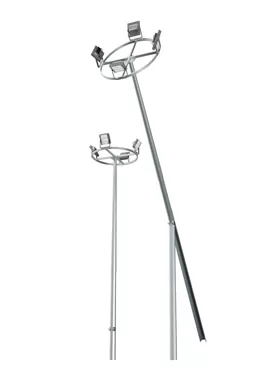
The number of fixtures installed on each mast affects structural load, electrical capacity, aiming flexibility and lighting distribution. A mast with six fixtures does not automatically replace two masts with three fixtures each.
| Preliminary Fixture Quantity | Fixtures per Mast | Calculated Mast Quantity | Planning Note |
|---|
| 12 | 4 | 3 | Suitable only when three positions provide sufficient overlap. |
| 12 | 3 | 4 | May improve distribution across a rectangular site. |
| 18 | 6 | 3 | Requires careful aiming and structural load review. |
| 18 | 3 | 6 | Uses more foundations but may improve uniformity. |
The most economical solution is not always the design with the fewest poles. Reducing mast quantity can increase mast height, fixture wattage, steel requirements, foundation size, cable load and glare risk. Total project cost should include equipment, foundations, wiring, installation and long-term maintenance.
Why Mast Height, Optics and Spacing Change the Result
Increasing the mounting height can extend the potential coverage area, but it also increases the distance between the luminaires and the working surface. The design may require higher-output fixtures or more controlled optics to maintain the required ground-level illuminance.
Fixture optics determine where the light is distributed. Wide-beam optics can support broad nearby coverage, while narrow or medium beams may project light toward more distant areas. Asymmetric optics are useful when fixtures are installed along the edge of a yard and must direct light inward.
Mast spacing also determines whether the beams overlap correctly. Excessive spacing may create dark strips between poles, while insufficient spacing can produce bright hotspots and waste energy. A successful high mast lighting design calculation must therefore evaluate quantity together with mounting height, optics, aiming and spacing.
Why a Manual Calculation Is Not the Final Lighting Design
The lumen method assumes that light is distributed efficiently across a relatively regular area. Real project sites often contain buildings, cranes, container stacks, trees, signs, elevated roads and other obstacles that block or redirect light.
A professional lighting simulation can evaluate:
Average, minimum and maximum illuminance
Overall and local lighting uniformity
Dark areas between high masts
Fixture aiming directions and beam overlap
Glare toward drivers, workers or nearby properties
Obstructions and irregular site boundaries
Alternative mast heights and fixture configurations
The preliminary formula is suitable for comparing concepts and preparing a budget. The simulation is needed to determine whether the proposed layout can meet the actual project requirements.
What Information Should You Send for a Professional Design?
To prepare an accurate layout, provide PHB Lighting with the following project information:
A DWG, PDF or dimensioned site plan
The type of application and nighttime activities
The required average and minimum lux levels
The preferred mast height, when already specified
Buildings, container stacks and other obstacles
Restricted foundation or installation locations
Local wind conditions and structural requirements
Grid-powered or solar power supply
Required operating hours and control method
We can use these inputs to compare mast height, LED wattage, fixture quantity, optical distribution and installation positions before the final equipment configuration is confirmed.
Frequently Asked Questions About High Mast Lighting Calculations
How many high mast lights do I need per square meter?
There is no fixed number per square meter. The result depends on target lux, fixture lumens, utilization factor, maintenance factor, mast height, optics and site layout.
What is UF in a high mast lighting design calculation?
UF means utilization factor. It estimates the proportion of the luminaire output that reaches the intended working area after considering beam distribution, aiming and layout efficiency.
What is MF in a high mast lighting calculation?
MF means maintenance factor. It allows for reduced light output caused by dirt accumulation, LED lumen depreciation and other changes during the system's operating life.
Can fixture wattage determine the number of high mast lights?
No. Wattage indicates power consumption rather than delivered light output. Use fixture lumens and photometric data when comparing LED high mast luminaires.
Does a higher mast reduce the number of poles?
It may increase coverage and reduce pole quantity, but it can also require more powerful fixtures, stronger structures and larger foundations. The layout must be checked for lux, uniformity and glare.
Do I need a lighting simulation after using the formula?
Yes, for large or safety-sensitive projects. A simulation verifies pole locations, fixture aiming, minimum lux, uniformity, shadows and glare before procurement and construction.
Conclusion
A basic high mast lighting design calculation helps estimate the required LED fixture quantity and convert it into an initial number of high mast poles. The key inputs are site area, target lux, fixture lumens, utilization factor, maintenance factor and fixtures per mast.
However, a mathematical estimate cannot fully represent an actual port, airport, logistics yard, highway interchange or industrial site. Use the formula for early budgeting, then verify the result through photometric simulation before ordering equipment, installing cables or constructing foundations.

 English
  français
  Deutsch
  Español
  русский
  português
  العربية
  Afrikaans
  עברי
עברי  Latinae
  Pilipino