Selecting the correct high mast light pole height is one of the most important decisions in a large-area lighting project. A taller pole can distribute light across a wider area, but it may also require higher-output LED luminaires, more controlled optics, a stronger steel structure, and a larger foundation.
The most suitable height cannot be selected from the site area alone. Designers must also consider the required lux level, lighting uniformity, glare limits, fixture quantity, beam angle, installation positions, obstructions, and local wind conditions. This guide compares common high mast heights from 18 to 40 meters and explains how to confirm the final configuration through photometric simulation.
What Is the Standard Height of a High Mast Light Pole?
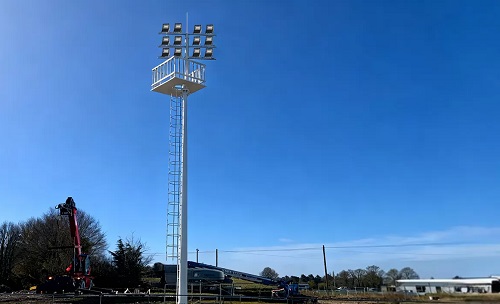
There is no single standard high mast pole height for every project. High mast lighting system generally uses taller poles than conventional street lighting and carries multiple high-output luminaires on a fixed headframe or lowering ring.
Common project heights include 18m, 20m, 25m, 30m, 35m, and 40m. The appropriate choice depends on the size and shape of the illuminated area and the activity taking place within it.
18m High Mast: Suitable for moderately sized parking, logistics, and industrial areas.
20m High Mast: A common starting point for road junctions, storage yards, and transport facilities.
25m High Mast: Used for larger highway, port, and industrial applications requiring broader coverage.
30m High Mast: Suitable for large interchanges, airport aprons, ports, and expansive logistics yards.
35m High Mast: Used where fewer installation positions must cover a very large operational area.
40m High Mast: Generally selected for major infrastructure and large sites requiring long-distance light projection.
The final height of high mast lighting must also satisfy structural requirements. Wind speed, luminaire wind area, pole material, foundation conditions, and maintenance access become increasingly important as the pole becomes taller.
High Mast Pole Height Comparison: 18m, 20m, 25m, and 30m
| Pole Height | Relative Coverage | Common Applications | Design Considerations |
|---|
| 18m | Moderate | Parking lots, small logistics yards, and industrial areas | May require more poles when the site is wide or irregular |
| 20m | Moderate to wide | Road junctions, distribution centers, and public squares | Balances coverage, structural requirements, and maintenance access |
| 25m | Wide | Ports, highways, storage yards, and large industrial sites | Requires careful optic selection and stronger structural design |
| 30m | Very wide | Airport aprons, highway interchanges, ports, and large terminals | May need higher fixture output, narrow or asymmetric optics, and a larger foundation |
An 18m or 20m pole may be more suitable when the site contains buildings, trees, stacked materials, or other obstructions. More poles can be positioned around these obstacles to improve lighting distribution.
25m high mast lighting is often considered when a project needs wider coverage without moving immediately to a 30m structure. It can provide a practical balance between pole quantity, fixture output, and installation cost.
30m high mast lighting is more appropriate for expansive open sites. However, increasing the height from 25m to 30m does not automatically reduce the total number of poles. A photometric layout must confirm whether the additional height improves usable coverage and uniformity.
How High Mast Light Height Affects Coverage, Spacing, and Uniformity
A greater high mast light height allows the luminaires to project light across a larger potential area. This may allow designers to increase the spacing between poles or reduce the number of foundation locations.
However, the distance between the luminaires and the ground also increases. If the same fixtures are moved from a lower pole to a taller pole without changing the wattage, optics, or aiming angles, ground-level illuminance may decrease.
Pole spacing must provide sufficient overlap between adjacent lighting zones. When masts are placed too far apart, dark areas may form between them. When they are too close together, excessive overlap can create bright hotspots, consume unnecessary energy, and increase equipment costs.
Uniformity is especially important in ports, airports, logistics yards, and highway areas. Operators and drivers must be able to see vehicles, obstacles, markings, and moving equipment without repeatedly adapting between bright and dark zones.
The site shape also affects spacing. A square open yard may support a symmetrical mast arrangement, while a long terminal, curved interchange, or irregular storage area may require additional poles or asymmetric positioning.
How Pole Height Changes LED Wattage, Fixture Quantity, and Beam Angle
Pole height, fixture wattage, fixture quantity, and optical distribution must be designed together. One parameter should not be changed without reviewing the others.
LED Wattage and Lumen Output
Taller masts usually require luminaires with sufficient lumen output to maintain the target illuminance at ground level. Wattage alone should not be used to compare fixtures because LED efficiency and optical performance vary between products.
A higher-wattage luminaire is not always the best solution. Excessive output can cause glare and energy waste when the beam distribution is unsuitable for the mounting height and target area.
Fixture Quantity
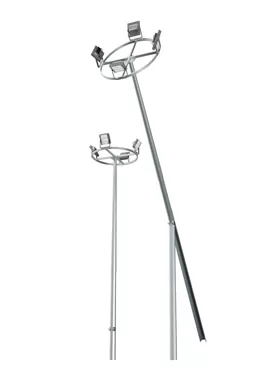
High mast systems may carry several luminaires arranged around a circular ring or directional frame. Increasing the number of fixtures can improve directional control and allow different parts of the site to be illuminated independently.
For example, a mast positioned near the center of an open yard may use a symmetrical arrangement. A mast installed along the boundary may require fewer outward-facing fixtures and more asymmetric luminaires directed into the site.
Beam Angle and Optical Distribution
Wide-beam optics distribute light over nearby areas but may not project efficiently from very tall poles. Medium or narrow beams can reach more distant zones, while asymmetric optics are useful for directing light forward from the edge of a site.
A complete design may combine several optical distributions on the same mast. This allows nearby areas, distant working zones, and perimeter sections to receive more consistent illumination.
Recommended High Mast Heights by Application
| Application | Preliminary Height Range | Main Design Priority |
|---|
| Large parking area | 18m to 25m | Uniform coverage, low glare, and controlled light spill |
| Highway interchange | 20m to 35m | Driver visibility, long-distance coverage, and glare control |
| Logistics or container yard | 20m to 35m | Visibility between vehicles, equipment, and storage areas |
| Port or cargo terminal | 25m to 40m | Wide operational coverage and resistance to harsh environments |
| Airport apron | 25m to 40m | High uniformity, controlled glare, and minimal obstruction |
| Industrial plant | 18m to 30m | Coverage around buildings, equipment, and working zones |
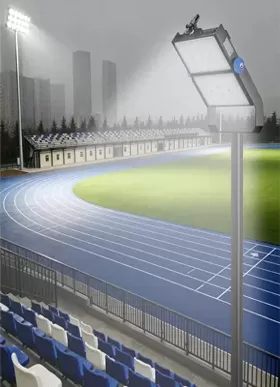
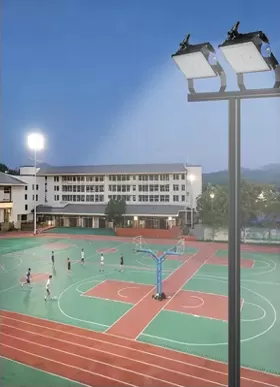
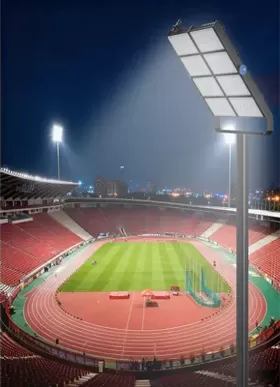
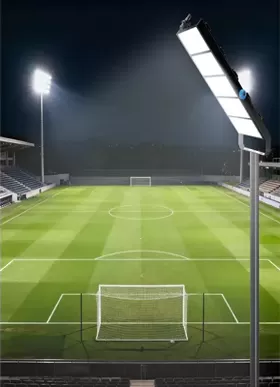
| Sports and stadium surroundings | 25m to 40m | High illuminance, vertical lighting, and precise aiming |
These ranges are suitable for early project planning but should not replace a site-specific design. A smaller site with a high lux requirement may need powerful fixtures on a lower mast, while a large open site with moderate lux requirements may benefit from taller poles and wider spacing.
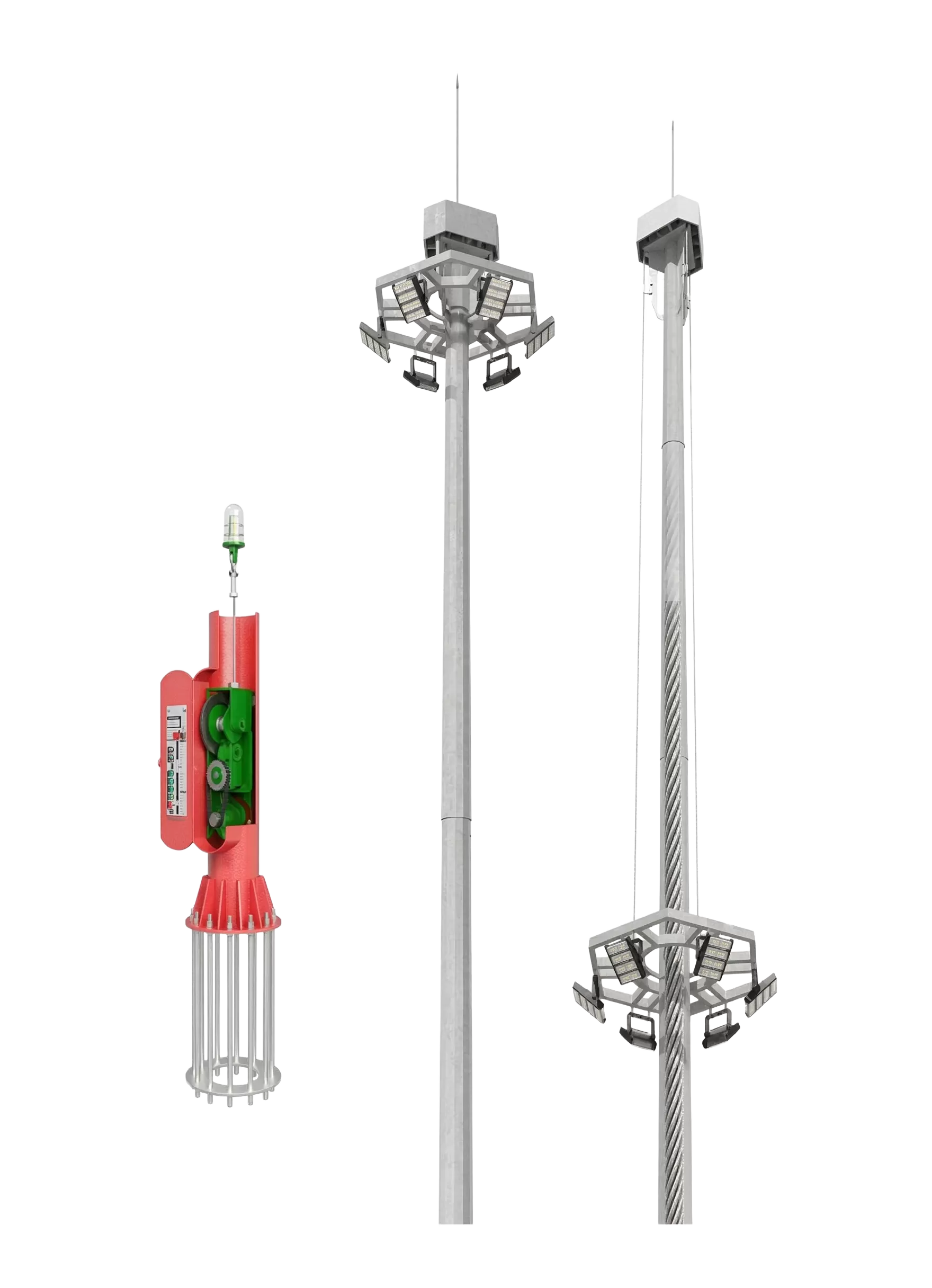
Maintenance also affects height selection. Taller fixed-head systems require suitable elevated access equipment. A lifting-system high mast can lower the luminaire ring to ground level, simplifying fixture inspection and replacement.
How to Confirm the Final Height with DIALux or Photometric Simulation
DIALux or another professional photometric platform should be used to compare possible high mast heights before the foundations and pole positions are finalized.
The simulation model should include:
Accurate site dimensions and boundaries
Proposed mast positions and mounting heights
IES or LDT photometric files for the selected luminaires
Fixture wattage, lumen output, and optical distribution
Aiming direction and tilt angle
Buildings, container stacks, and other obstructions
Required average, minimum, and maximum illuminance
Uniformity and glare requirements
Designers can then compare an 18m, 20m, 25m, or 30m configuration using the same project requirements. The results may show that a taller mast reduces pole quantity or that a lower arrangement provides better uniformity around obstacles.
At PHB Lighting, we can use the project drawing and lighting requirements to compare mast heights, luminaire quantities, wattages, and beam angles. The recommended solution should meet the required lighting performance while controlling structural complexity, energy consumption, and installation cost.

Frequently Asked Questions About High Mast Pole Height
What is the most common high mast light pole height?
There is no universal height, but 20m, 25m, and 30m are common starting points for large outdoor projects. The final height depends on the area, application, lux level, and site layout.
Is an 18m pole considered a high mast?
An 18m pole may be treated as a high mast or tall floodlighting pole depending on the project specification and local terminology. Its structure and multi-luminaire configuration are more important than the name alone.
Is 25m high mast lighting suitable for a logistics yard?
Yes, a 25m system can suit many logistics yards, but the layout must account for storage racks, containers, buildings, vehicle routes, and required lux levels.
When should 30m high mast lighting be used?
A 30m system is commonly considered for large, open areas such as airport aprons, ports, highway interchanges, and expansive industrial sites requiring broad coverage.
Does a taller high mast always require higher-wattage lights?
Not always, but greater mounting distance often requires higher delivered lumen output or more controlled optics. Photometric simulation should determine the appropriate fixture configuration.
Can high mast pole height be selected without DIALux?
A preliminary height can be estimated from the site and application, but a professional simulation is recommended to verify lux levels, uniformity, glare, pole spacing, and fixture aiming.
Conclusion
The correct high mast light pole height balances coverage, ground-level illuminance, uniformity, glare, fixture output, structural requirements, and project cost. An 18m or 20m mast may suit moderately sized areas, while 25m, 30m, 35m, and 40m systems are generally considered for progressively larger and more open sites.
Do not select the final height from a general table alone. Compare alternative pole heights through photometric simulation using the actual site drawing, target lux level, and luminaire data. This approach helps determine whether the project needs more lower poles, fewer taller poles, or a mixed configuration designed around the site's real operating conditions.

 English
  français
  Deutsch
  Español
  русский
  português
  العربية
  Afrikaans
  עברי
עברי  Latinae
  Pilipino